


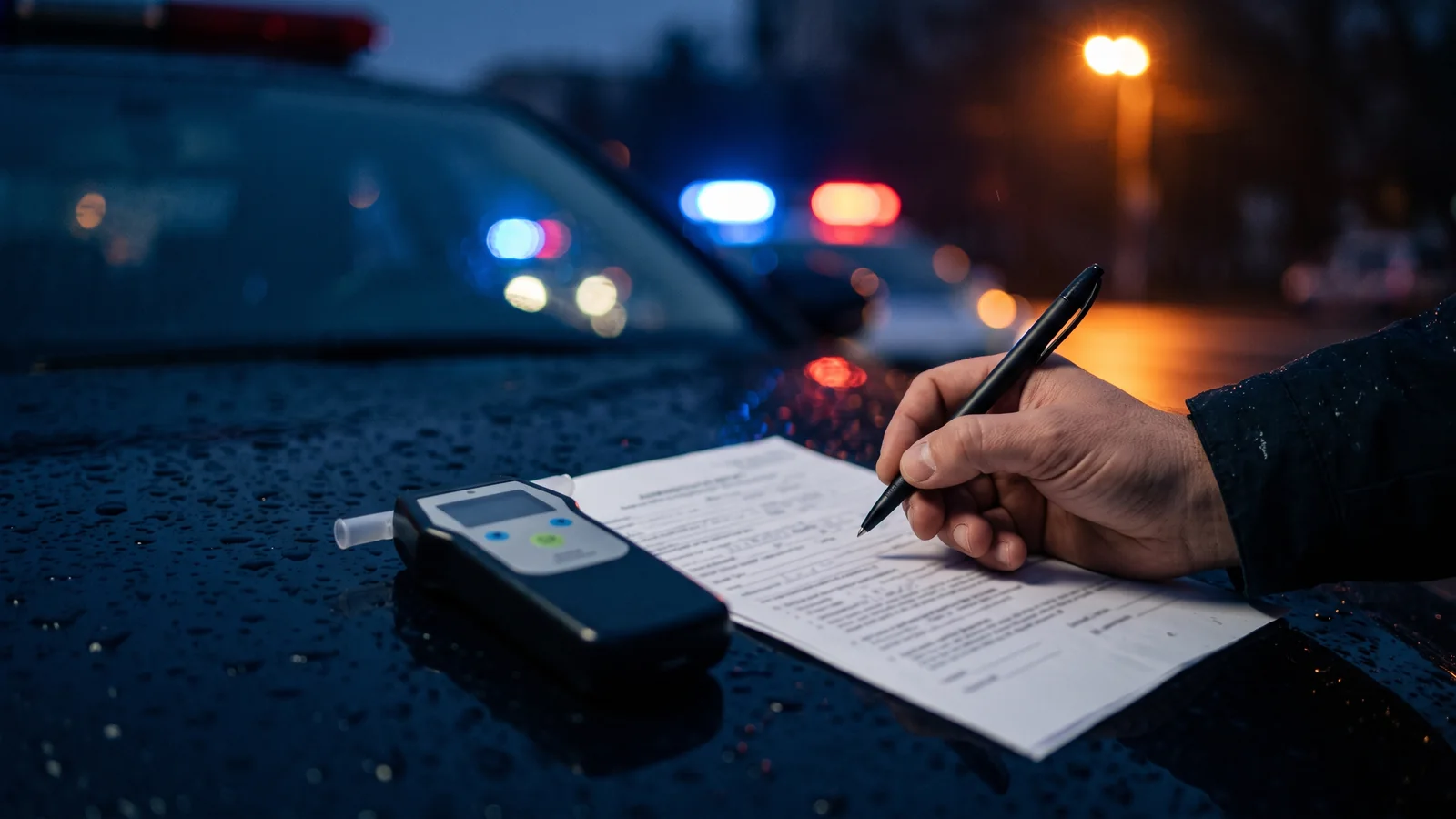
Article 130 of the Code of Ukraine on Administrative Offences (CUAO) means a year without a driving licence and a fine of a thousand tax-free minimum incomes for a first offence alone. But a police report is not a verdict: the case goes to court, and it is there that the judge checks whether the fact of driving was proven, whether the breath/medical test was documented correctly, and whether the deadline for imposing a penalty has passed. In cases of this category I have achieved discontinuance of proceedings in first-instance courts and reversal of rulings on appeal — below is a list of decisions with links to the register. This article breaks down which arguments actually worked.
In brief: 7 points
- Refusing the sobriety test counts as being intoxicated — liability arises under the same Article 130 of the CUAO.
- The main fact the police must prove is that the person was driving. If that is not proven, there is no offence.
- Errors in the report and the test act are the main line of defence.
- There is a statutory deadline for imposing a penalty. Missing it is an independent ground for closing the case.
- Only 10 days to appeal. The court of appeal is the final instance in administrative offence cases.
- Minor significance (Article 22 of the CUAO) is a rare but real option: in one of my cases the court limited itself to an oral warning.
- The list below has 20 decisions in cases of this category that I handled: 13 in first-instance courts and 7 on appeal.
What Article 130 of the CUAO provides for
| Situation | Fine | Driving ban (suspension of the licence) | Additional |
|---|---|---|---|
| First offence | 1,000 tax-free minimum incomes | 1 year | — |
| Repeated within a year | 2,000 tax-free minimum incomes | 3 years | paid seizure of the vehicle |
| Third time (second penalty within a year) | 3,000 tax-free minimum incomes | 10 years | confiscation of the vehicle |
| Consumption after an accident or after being stopped | 2,000 tax-free minimum incomes or up to 15 days of arrest | 3 years | — |
The same article covers not only driving while intoxicated, but also letting an intoxicated person drive and refusing to take the sobriety test. So the calculation "I'll refuse and nothing will happen" does not work: liability arises under the same provision.
Fine amounts in hryvnias depend on the currently applicable tax-free minimum income, and the wording of the article changes from time to time. Check the exact amount as of the date of your case.
What the police actually have to prove — and where they get it wrong
The case against a driver rests on two elements: the person was driving the vehicle and was intoxicated. A gap in either one breaks the case.
- The fact of driving. The most common weakness. The car is parked, the person is nearby or inside, there are no witnesses to the vehicle moving, no video survives — yet the report says "was driving".
- The state of intoxication. Here the procedure is checked: what device was used, whether it was in working order, whether the procedure was followed, whether a test act exists and is correctly drawn up.
- How the report was drafted. Incomplete data, a missing signature or note confirming rights were explained, failure to hand over a copy — all of this is checked.
- Deadlines. A penalty cannot be imposed after the time limit set by the CUAO has expired.
Three arguments that worked in my cases
The fact of driving was not proven
In a case reviewed by the court of appeal, the client had been found guilty under Part 1 of Article 130 of the CUAO, yet neither the fact of driving nor the lawfulness of the stop had been proven. The defence pointed to the lack of evidence of driving and to breaches in the testing procedure, and separately to defects in the report. The court of appeal reversed the ruling and discontinued the proceedings (decision).
Drafting errors and deleted video footage
In another case the file contained procedural defects: the report was drawn up with violations, and the evidence of driving itself was insufficient. The court of appeal granted the complaint and discontinued the proceedings for lack of an offence (decision).
It is worth knowing separately that video footage is kept only for a limited time. If a recording that could have supported your position has been deleted, that circumstance works against the prosecution — but a request to obtain the footage must be filed immediately, not months later.
Minor significance under Article 22 of the CUAO
This is an option almost nobody writes about. The client had been fined and had his licence suspended; the evidence raised doubts about the accuracy of the measurements. The defence showed that the evidence was unconvincing and pointed to procedural violations, asking the court to apply Article 22 of the CUAO. The court of appeal released the client from the penalty due to minor significance, limiting itself to an oral warning (decision).
Minor significance is an exception, not the rule, and should not be relied on as the main line of defence. It works when the prosecution's evidence base is already weak on its own.
List of decisions in cases I have handled
The circumstances differ — from unproven driving to missed deadlines and procedural violations. The texts are public, and the links lead to the Unified State Register of Court Decisions.
First-instance courts: 1, 2, 3, 4, 5, 6, 7, 8, 9, 10, 11, 12, 13.
Courts of appeal: 1, 2, 3, 4, 5, 6, 7.
These are results of specific cases with specific case files. The result of one case does not automatically carry over to another: if the fact of driving is captured on video, the test was carried out correctly, and the report has no defects, the prospects for a defence narrow considerably, and it is more honest to say so from the start.
What to check in the sobriety test act
The act recording the sobriety test is the document around which half of the cases in this category are built. What matters is not the result but the procedure:
- whether it states exactly which device was used, its serial number, and its calibration data;
- whether the time of the test matches the time of the stop and of drawing up the report;
- whether the right to be tested at a medical facility was explained, and whether the answer was recorded;
- whether all participants signed the act and whether a copy was handed over;
- whether the data in the act is consistent with the report and with the video footage.
Discrepancies between these documents are not a minor detail. They were exactly the basis of the arguments in cases where the proceedings were discontinued for lack of an offence.
When a case can turn into a criminal one
Article 130 of the CUAO carries administrative liability. But if the same situation involves victims and bodily injury, the matter goes beyond the CUAO and can be handled as a criminal case. This is a fundamentally different procedure, with different deadlines and different consequences — for how defence counsel works in such cases, see the separate page on defence in criminal cases.
That is why the initial assessment of the file should cover both directions at once: the exposure under the administrative article, and whether there is a risk of criminal classification.
The deadlines people miss most often
- 10 days to file an appeal from the day the ruling is issued. The appeal is the final court instance in this category of cases — there will be no other chance.
- The deadline for imposing a penalty is limited by the CUAO. If a case is "stuck" and heard late, that alone is grounds for discontinuing the proceedings.
- Video footage retention at the police is short. A request to obtain it must be filed immediately.
What to do in the first few days
- Get copies of all documents: the report, the test act, the device printout, and the ruling if one has already been issued.
- Put your version in writing — in the explanations attached to the report. The wording "was driving" versus "was not driving" matters.
- Do not sign documents whose content does not match reality, and do not agree to a "simplified" version on the spot.
- Request the video footage — from bodycams, the police car, and any nearby surveillance cameras.
- Gather witnesses: passengers, acquaintances, staff of nearby venues.
- Check the dates: when the report was drawn up, when the case was sent to court, when the hearing was scheduled.
- Do not miss the 10-day appeal deadline once a ruling has been issued.
Documents: what they are, where to get them, and why you need them
| Document | Where to get it | Why it matters |
|---|---|---|
| Administrative offence report | A copy is handed over on the spot; afterwards it is part of the case file in court | The main document: checked for accuracy of the data, signatures, and whether rights were explained |
| Sobriety test act | Case file | Used to check that the testing procedure was followed |
| Device printout | Case file | Measurement data and information about the device itself |
| Video footage | Request to obtain it | Key evidence for or against the fact of driving |
| Court ruling | Court | The appeal deadline is counted from the date it is issued |
| Medical records, if the test was carried out at a facility | Medical facility | Checking that the testing procedure was followed |
| Witness details | Gathered independently | Confirmation of the circumstances of the stop and of driving |
Mistakes that cost people their licence
- Signing the report "just to be let go faster". It then has to be disproved later.
- Not writing an explanation. A blank field is interpreted against you.
- Not showing up in court. The case will be heard without you, based on the police's materials.
- Missing the 10-day appeal deadline. This is the final instance, and restoring the deadline is a separate fight.
- Requesting the video too late. Recordings are deleted once the retention period expires.
- Building a defence on emotion. The court weighs procedure and evidence, not the circumstances of the driver's life.
Frequently asked questions
I was stopped while my car was parked. Does Article 130 already apply?
The key question in any such case is whether the fact of driving was proven, because without it there is no offence. Simply being inside or near the car does not amount to driving it. In practice this is exactly where the prosecution is most often weak: there are no witnesses to the car moving, no surviving video, and the report simply states "was driving". In a case I handled, the court of appeal reversed the ruling and discontinued the proceedings precisely because neither the fact of driving nor the lawfulness of the stop had been proven. That is why, in the explanations attached to the report, it is essential to clearly set out your version: where the car was parked, who was behind the wheel, and when and by whom it stopped moving. Those few sentences later determine what the defence is built on. If you already wrote something different, or wrote nothing, the situation is not hopeless, but proving your case becomes harder and will rely on video and witnesses.
What happens if I refuse the sobriety test?
Refusing the test triggers liability under the same Article 130 of the CUAO as driving while intoxicated. In other words, the calculation "I won't take it, so nothing can be proven" does not work: the consequences are the same, and the defence's position becomes harder, since you have voluntarily given up the chance to prove sobriety. That said, it does not mean the case is automatically lost: what is checked is whether the refusal was properly recorded, whether the consequences were explained, whether the procedure for offering the test was followed, and whether there is evidence of driving itself. If the fact of driving is not proven, the refusal issue no longer decides the outcome, and the proceedings can be discontinued for lack of an offence. The prospects should therefore be assessed on the whole set of documents, not just on the fact of the refusal alone.
How much time do I have to appeal a court ruling?
Ten days from the day the ruling is issued. This is a short and strict deadline, and in administrative offence cases the court of appeal is the final court instance — there is no cassation stage. Missing those ten days effectively closes the matter, leaving only a fight to restore the deadline, which requires evidence of a valid excuse. In my experience, most people lose their case exactly at this stage: the ruling is issued, the person is confused, did not receive the documents in hand immediately, and the deadline runs out in the meantime. So if a ruling has already been issued, the first step should not be searching for advice on forums but preparing an appeal. Seven of the decisions in the list above are appellate ones, and in some of them the first-instance rulings were reversed.
Can a case be closed because a deadline was missed?
Yes, and this is an independent ground that does not depend on whether you were intoxicated. The CUAO limits the period within which an administrative penalty may be imposed, and if a case is heard after that period expires, the proceedings must be discontinued. In practice this happens more often than it seems: files reach the court late, hearings are postponed, and the deadline runs out. That is why the first thing I check in the file is the dates: when the report was drawn up, when the case reached the court, and when the hearing was scheduled. In several of my cases, a missed deadline for imposing the penalty was, alongside other defence arguments, the ground for discontinuing the proceedings. So even in a situation that looks difficult at first glance, it is worth reviewing the file from this angle.
What is minor significance, and can it really be applied?
Article 22 of the CUAO allows a court to release a person from administrative liability where the offence is of minor significance, limiting itself to an oral warning. In Article 130 cases this is the exception, not the rule, and a defence should not be built on it alone. But the mechanism does work: in one of my cases the court of appeal did exactly that — it released the client from the penalty due to minor significance, limiting itself to an oral warning, after the defence showed that the evidence was unconvincing and pointed to procedural violations. In other words, minor significance works when the prosecution's evidence base is already weak on its own, even though the offence formally appears to exist. It is more of a fallback worth keeping in the file than a main line of defence. It makes sense to raise minor significance alongside the main arguments, not instead of them, otherwise it can look like an admission of guilt.
Is it worth hiring a lawyer if I really was drinking?
I will be honest: if the fact of driving is captured on video, the test was carried out correctly, and the report has no defects, the prospects for a defence narrow considerably, and I say so from the start. But even in that situation, questions remain that affect the outcome: whether the deadline for imposing the penalty was met, whether the documents were drawn up correctly, whether the stop was lawful, and whether there are grounds to apply minor significance. On top of that, a great deal depends on the exact classification: a first offence, a repeat offence within a year, or consumption after being stopped are different parts of the article with different consequences, up to confiscation of the vehicle. So the prospects should be assessed from the documents, not from how you feel about it. I say directly when the chances are low: there is no point paying for a process with a predictable outcome.
Have you received a report under Article 130 of the CUAO, or already have a court ruling? Send me the report, the test act, and the ruling if you have one — I will tell you whether the fact of driving is proven, whether there are procedural violations, and whether the deadline for imposing the penalty has passed. If a ruling has already been issued, remember the ten-day appeal deadline. Terms of work and prices are on the motoring lawyer services page. Consultations are held in Ukrainian or Russian; written communication in English is available.