


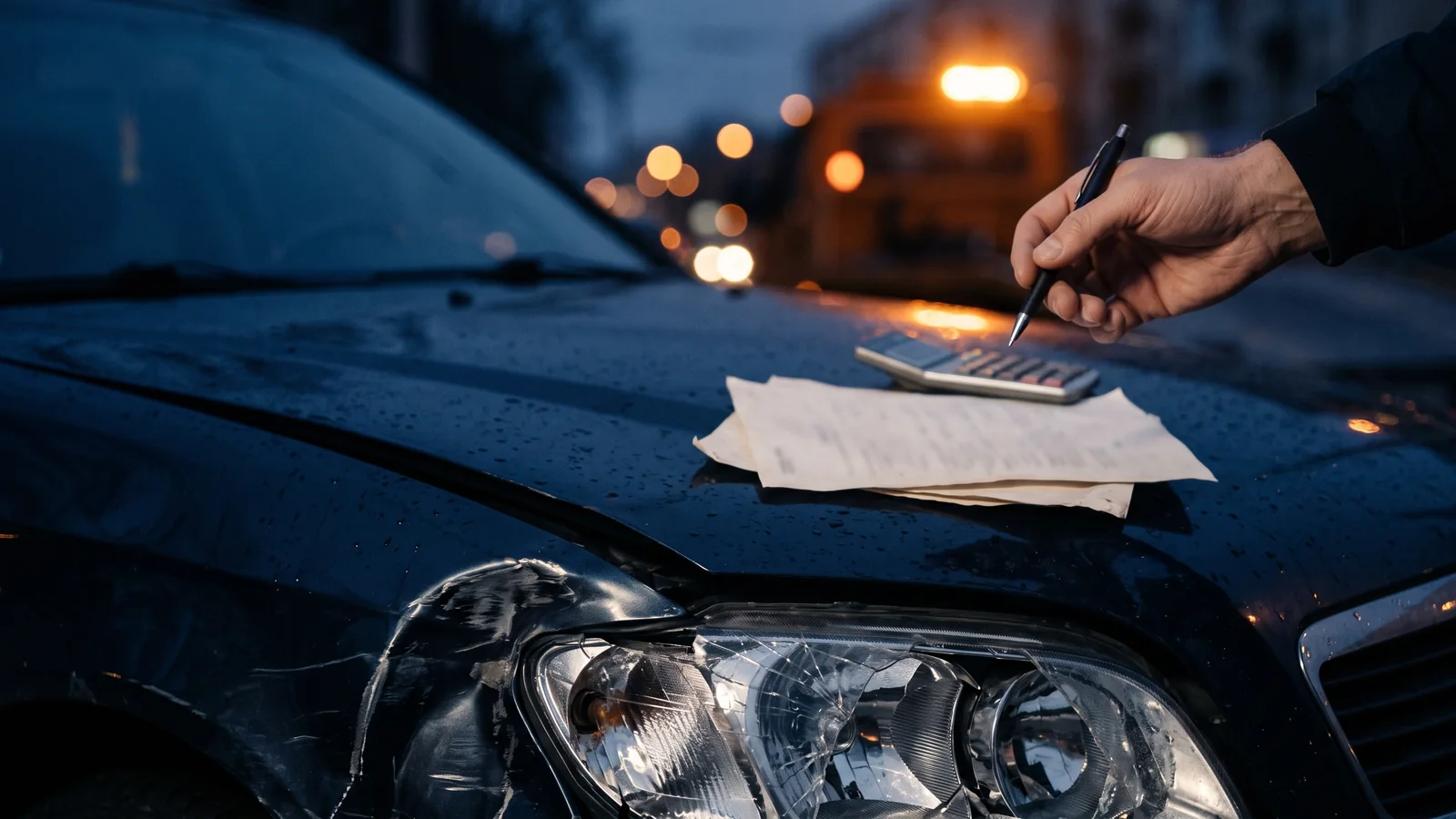
After a road traffic accident (RTA), the injured party receives a payout from the insurer, sees that repairs cost more, and sues the driver for the difference. In two cases where I defended the respondents, the courts fully denied recovery of material damage: in both, the car was physically destroyed, and in that case the law allows compensation only for the difference between the car's value before and after the accident — a sum the insurer had already covered. Here is how the court calculated it, why the repair cost was not the key figure, and how much was ultimately awarded from the claimants to my clients.
In brief: 6 points
- If repairs cost more than the car itself, the vehicle is considered physically destroyed — and what is compensated is not the repair, but the difference between its value before and after the accident (clauses 30.1 and 30.2 of Article 30 of the Law on Compulsory Motor Third-Party Liability Insurance, MTPL).
- As long as the damage stays within the insurer's limit, the driver at fault is not the proper respondent. Only the amount exceeding the insurance payout can be recovered from them (Article 1194 of the Civil Code of Ukraine).
- In case No. 236/1625/20 the claimant received 83,139.46 UAH from the insurer, a 1,300 UAH deductible, and another 120,000 UAH from selling the wrecked car — 204,439.46 UAH in total against 161,008.58 UAH in damage. The material-damage claim was dismissed.
- In case No. 357/17717/25 the insurer paid 301,847.89 UAH — exactly the difference between 591,323.85 UAH and 289,475.96 UAH. The court rejected the remaining 251,376.58 UAH claim as brought against the wrong respondent.
- Towing and re-appraisal costs do not automatically fall on the driver either: towing is covered by the insurer, and a second appraisal report may be found unnecessary by the court.
- A dismissed claim entitles the respondent to recover attorney's fees from the claimant. In one case 10,000 UAH was awarded; in the other, 3,000 UAH instead of the 22,000 UAH claimed.
Where the idea of a "top-up" from the at-fault driver comes from
The injured party's logic is simple: repairs cost 700,000 UAH, the insurer paid 300,000 UAH, so the "missing" 400,000 UAH should come from the at-fault driver. There is a legal basis for this: Article 1194 of the Civil Code of Ukraine — a person who has insured their civil liability must, if the insurance payout is insufficient, pay the injured party the difference between the actual amount of damage and the insurance payout.
The problem lies in the words actual amount of damage. It does not automatically equal the repair cost: for a car whose repair makes no economic sense, the law calculates damage differently. This is exactly the point that decided both cases below.
Physical destruction: when the repair cost stops being the measure
Clause 30.1 of Article 30 of the Law of Ukraine "On Compulsory Insurance of Civil Liability of Owners of Land Vehicles" sets out a simple rule. A vehicle is considered physically destroyed if repairing it is technically impossible or economically unjustified. Repairs are deemed unjustified when restoration costs exceed the car's own value before the accident.
Clause 30.2 spells out the consequence: the owner of a destroyed car is compensated for the difference between the vehicle's value before and after the accident, plus the cost of towing it from the accident scene. Not the repair cost — the difference, because the wrecked car remains with the owner and still has a price of its own.
In its ruling of 27 March 2019 in case No. 752/16797/14-ц, the Grand Chamber of the Supreme Court specifically stressed that if a vehicle is physically destroyed, its owner is compensated exclusively for the difference between its value before and after the accident, plus towing. This position became the foundation of the defence in both cases.
The insurer's limit and the figure of the "wrong respondent"
The second pillar of the defence is how liability is split between the insurer and the driver. The Grand Chamber of the Supreme Court consistently holds that the main burden of compensating accident damage falls on the insurer, who is the proper respondent within the insured sum (rulings of 3 October 2018 in case No. 760/15471/15-ц and of 9 November 2021 in case No. 147/66/17). The driver's liability begins where the insurer's liability ends — when the insurer's payment obligation never arose, or when the damage exceeds the limit. No difference means no grounds for a claim against the driver.
Both decisions discussed below are first-instance court decisions that, as of the publication date, have not entered into legal force: case No. 236/1625/20 became final on 25 June 2024, and case No. 357/17717/25 on 16 June 2026.
Case No. 236/1625/20: when the injured party received more than they lost
The accident happened on 6 December 2019 in Lyman, Donetsk region. The driver whose interests I represented failed to choose a safe speed and collided with a Honda Civic. A court ruling of 5 March 2020 found him guilty of an offence under Article 124 of the Code of Ukraine on Administrative Offences (CUAO); the criminal proceeding under Part 1 of Article 286 of the Criminal Code of Ukraine was closed. We did not dispute fault — the dispute was solely about the amount.
The claimant sought 117,067.54 UAH in material damage, 10,000 UAH in moral damages for himself, and 20,000 UAH for his minor son. His calculation was based on appraisal report No. 98/03, commissioned by the insurer: repair cost — 663,671.72 UAH, market value — 200,207.00 UAH. The insurance payout and the deductible were subtracted from that market value.
The weakness of this calculation lay in what the report left out. The appraiser found the car physically destroyed but did not determine its residual value as of the accident date. In other words, the formula was missing exactly the component that clause 30.2 of Article 30 of the Law makes decisive. At the respondent's request, the court ordered a forensic vehicle-valuation examination.
What the forensic examination showed
Expert opinion No. 383-384 of 23 March 2021, issued by the Donetsk Research Institute of Forensic Examinations, gave the full picture.
| Indicator | Appraisal report No. 98/03 | Expert opinion No. 383-384 |
|---|---|---|
| Cost of restoration repair | 663,671.72 UAH | 318,590.20 UAH |
| Market value of the car before the accident | 200,207.00 UAH | 161,008.58 UAH |
| Residual value after the accident | not determined | 40,643.66 UAH |
| Amount of material damage | 200,207.00 UAH | 161,008.58 UAH |
The court accepted the expert opinion as proper evidence: it had been prepared pursuant to a court order, and the expert had been warned of criminal liability.
The arithmetic that settled the matter
The defence then added another document to the case file — a reply to an attorney's inquiry from a Ministry of Internal Affairs (MIA) service centre. It showed that on 16 October 2020 the claimant sold the damaged Honda Civic for 120,000 UAH. This figure changed the whole calculation.
| What the claimant received | Amount |
|---|---|
| Insurance payout from the insurer | 83,139.46 UAH |
| Deductible, voluntarily paid by the respondent | 1,300.00 UAH |
| Proceeds from selling the damaged car | 120,000.00 UAH |
| Total | 204,439.46 UAH |
| Amount of damage per the expert opinion | 161,008.58 UAH |
The court found that what the claimant received exceeded the damage caused by the accident — exceeding it under both the expert opinion and the appraisal report. Finding no lawful grounds to recover material damage from the respondent, the court dismissed this part of the claim.
The court partially awarded moral damages: 5,000 UAH to the claimant instead of 10,000 UAH, and 10,000 UAH to his minor son instead of 20,000 UAH, applying Article 23 of the Civil Code of Ukraine and the principles of reasonableness and fairness. The claimant's court costs were compensated within the scope of the granted claims — 2,000 UAH in legal fees and 150 UAH in court fee. And since the material-damage claim was dismissed, the court awarded my client 10,000 UAH in legal fees from the claimant.
Case No. 357/17717/25: the insurer paid exactly what it owed
The second case was heard by the Bila Tserkva City-District Court of Kyiv Region and ended with a judgment of 15 May 2026. The accident happened on 3 February 2025 at the 79th kilometre of the Kyiv–Odesa highway: my client, while changing lanes, failed to give way to a Mercedes-Benz Sprinter.
The question of fault was also not straightforward: the court first closed the administrative proceeding for lack of an offence, but the Kyiv Court of Appeal reversed that ruling on 19 May 2025 and found the respondent guilty under Article 124 of the CUAO, closing the proceeding because the time limit for imposing a penalty had expired. Fault in the civil case was therefore not in question — we admitted the claim as to 3,000 UAH in moral damages and objected to the rest.
The claimant sought 262,676.58 UAH, comprising 251,376.58 UAH in damage above the insurance payout, 6,500 UAH for the appraisal, 4,800 UAH for towing, and 3,000 UAH in moral damages.
Why the difference had already been paid
The defence's key argument relied on the insurer's own figures. My client's liability was insured not only under an MTPL policy with a 160,000 UAH property limit, but also under a comprehensive insurance contract with a sum insured of 1,050,000 UAH — 1,210,000 UAH combined.
| Indicator, per the report commissioned by the insurer | Amount |
|---|---|
| Cost of restoration repair | 700,069.69 UAH |
| Market value of the car before the accident | 591,323.85 UAH |
| Value of the car in its damaged state | 289,475.96 UAH |
| Difference, i.e. the insurance payout | 301,847.89 UAH |
The repair cost (700,069.69 UAH) turned out to exceed the car's own value before the accident (591,323.85 UAH) — meaning the vehicle was physically destroyed. The insurer paid the difference between the before- and after-accident value in two instalments on 14 and 16 July 2025. Notably, that was the very amount the claimant himself had requested in his insurance-payout application of 1 July 2025 — meaning he agreed with the residual-value assessment.
The court found the 251,376.58 UAH claim to have been brought against the wrong respondent: the damage did not exceed the insurance cover, so there was no difference for the driver to pay under Article 1194 of the Civil Code of Ukraine.
Towing and the second appraisal
The court dismissed the two smaller claims on separate grounds, both worth remembering.
- Towing — 4,800 UAH. Article 28 of the MTPL Law directly classifies towing a vehicle from the accident scene as damage to the injured party's property, and Article 29 includes such costs in the insurance payout. Towing is the insurer's obligation to pay, so the claim against the driver was addressed to the wrong party.
- Appraisal — 6,500 UAH. The claimant commissioned his own report No. 158/ч/25 dated 13 August 2025 after report No. 90213 of 26 June 2025, prepared for the insurer, already existed. The court saw no purpose in a second appraisal and denied recovery of that cost.
In the end, the respondent was ordered to pay the admitted 3,000 UAH in moral damages and 30 UAH in court fee. The rest of the claim was dismissed.
Attorney's fees: how 22,000 UAH became 3,000 UAH
A separate storyline in both cases is the allocation of legal costs. This is the part where winning on the merits does not necessarily mean full compensation.
In case No. 236/1625/20, the fee was fixed at 10,000 UAH by an additional agreement and paid by the client — the court awarded the full amount from the claimant.
In case No. 357/17717/25, it went differently. The respondent's costs were 22,000 UAH, evidenced by the agreement, an additional agreement, an act of services rendered, and two payment orders. The claimant's representative objected to the amount, and the court treated the objection as a request for reduction. Taking into account the value of the claim, the case's classification as low-complexity, participation in hearings by videoconference, and the volume of documents prepared, the court reduced the compensation from 22,000 UAH to 3,000 UAH, citing the criteria of validity, necessity and reasonableness of costs.
Tellingly, the court did not compensate the claimant's own attorney's fees at all: the case file contained no additional agreement fixing the agreed fee amount, even though the underlying agreement referred to one. A formal gap in the paperwork cost that side the entire sum.
At the same time, the court rejected the argument that a detailed breakdown of work performed was mandatory: following the Supreme Court's position of 28 December 2020 in case No. 640/18402/19 and the Grand Chamber's of 16 November 2022 in case No. 922/1964/21, such a breakdown is not an end in itself for a fixed fee, and its absence alone does not block recovery.
What this means for a driver named as respondent
Both cases show that a claim "for the difference" falls apart not on emotion but on documents. A practical sequence of steps looks like this:
- Check whether the car is physically destroyed. Compare the repair cost with the car's market value before the accident. If the repair costs more, the discussion shifts to a "before and after" comparison, and the repair cost loses its relevance.
- Find the residual value. A report without it is incomplete. In the first case, exactly this gap was the reason the court ordered a forensic examination.
- Check what happened to the wrecked car. An attorney's inquiry to the MIA service centre shows whether the car was sold, and for how much. In case No. 236/1625/20, 120,000 UAH in proceeds settled the matter for good.
- Add up everything the injured party received. The insurance payout, the deductible, and sale proceeds together may exceed the damage.
- Check the insurer's limits. Besides MTPL, a voluntary policy may apply, pushing the boundary of the driver's liability much further away.
- Document your own fee without gaps. An agreement, an additional agreement stating the amount, an act, and payment documents — otherwise there will be no compensation even if the claim is dismissed.
If you have received a claim after a road traffic accident, or conversely are weighing whether it makes sense to sue the driver after an insurance payout, the calculation is worth doing before filing any documents. For more on handling such disputes, see the road traffic accident lawyer page. If the accident involved bodily injury and proceedings were opened under Article 286 of the Criminal Code of Ukraine, a parallel criminal defence track also applies.
Frequently asked questions
Can the difference between the repair cost and the insurance payout be recovered from the at-fault driver?
Only if the actual amount of damage genuinely exceeds the insurance payout. The key word is "actual." When repairs cost more than the car itself was worth before the accident, the vehicle is considered physically destroyed, and under clause 30.2 of Article 30 of the MTPL Law, the damage is the difference between the car's value before and after the accident, not the repair cost. In case No. 357/17717/25 the repair was valued at 700,069.69 UAH, the car before the accident at 591,323.85 UAH, and the residual value at 289,475.96 UAH. The insurer paid exactly the difference — 301,847.89 UAH — and the court refused to recover a further 251,376.58 UAH from the driver, citing the wrong respondent. So the starting point should not be calculating the repair, but checking whether any excess over the payout exists at all.
What does it mean for a car to be recognised as physically destroyed?
It is a legal conclusion, not the condition of the metal. Under clause 30.1 of Article 30 of the MTPL Law, a vehicle is considered physically destroyed if repair is technically impossible or economically unjustified, meaning restoration costs exceed the car's value before the accident. The car may still look repairable and even actually be repaired. Either way, the consequence is the same: what is compensated is the difference between its value before and after the accident, plus towing from the accident scene. The Grand Chamber of the Supreme Court, in case No. 752/16797/14-ц, confirmed that for a destroyed car only this difference is compensated. That is exactly why a report that does not determine residual value is incomplete for a court and easy to challenge.
Is the price the injured party sold the wrecked car for taken into account?
Yes, and it can become decisive evidence. Residual value is not an abstraction — it is the real price at which a wrecked car is sold. In case No. 236/1625/20, the claimant sold his damaged Honda Civic for 120,000 UAH ten months after the accident. Together with the 83,139.46 UAH insurance payout and the 1,300 UAH deductible, he received 204,439.46 UAH — against 161,008.58 UAH in damage under the forensic examination's findings. The court found the excess and dismissed the material-damage claim in full. The sale came to light through an attorney's inquiry to the territorial MIA service centre, which is a step worth taking in every similar case.
Who compensates towing costs after a road traffic accident?
The insurer, not the driver who caused the accident. Article 28 of the MTPL Law directly classifies towing a vehicle from the accident scene as damage to the injured party's property, and Article 29 includes such costs in the payout — covering towing to the owner's residence or to a repair shop, and, if needed, to a car park along with parking fees. In case No. 357/17717/25 the claimant paid 4,800 UAH to have the car towed from Bila Tserkva to Kyiv and sought that amount from the driver. The court refused, noting that the claim was addressed to the wrong respondent. The same money could have come from the insurer — the only question is who it should be claimed from.
Will I be compensated for my attorney's fees if the court dismisses the claim against me?
The right to compensation arises, but the amount is set by the court. Under Article 141 of the Civil Procedure Code of Ukraine, costs are allocated to the claimant if the claim is dismissed, and proportionally between both sides if it is partially granted. In case No. 236/1625/20 the court awarded the full fee — 10,000 UAH — from the claimant. In case No. 357/17717/25 the court reduced the claimed 22,000 UAH to 3,000 UAH, taking into account the other side's objections, the value of the claim, and the case's low-complexity classification. A full set of documents is essential: the agreement, an additional agreement stating the specific fee amount, an act of services rendered, and proof of payment. The claimant in the second case was denied compensation precisely because there was no additional agreement on the amount.
Does admitting fault for the accident reduce the amount awarded?
Admitting fault and admitting the amount claimed are different things, and it is worth keeping them apart. In both cases described here, the respondents' fault had been established by administrative-offence rulings under Article 124 of the CUAO, and there was no point disputing it: under Part 6 of Article 82 of the Civil Procedure Code of Ukraine, such rulings are binding on the court as to whether the acts took place and whether that person committed them. The defence rested entirely on the amount of damage and on who the proper respondent was. In the second case, we admitted 3,000 UAH in moral damages right away — that did not weaken the position on the rest of the claims. The outcome of one case does not automatically carry over to another: every calculation depends on its own documents.
This material is based on first-instance court decisions in cases where I represented the respondents. The court decisions are available in the Unified State Register of Court Decisions: case No. 236/1625/20 and case No. 357/17717/25. This article is for informational purposes and is not legal advice for your situation.
Have you received a claim after a road traffic accident, or are you unsure whether you are lawfully being asked to pay more than the insurance payout? Write to me — we will review your documents and work out whether the claim has any basis at all. Consultations are held in Ukrainian or Russian; written communication in English is available.